previous
Project Horseshoe 2011
| The Sixth Annual Game Design Think Tank Project Horseshoe 2011 |
 |
Group Report: Practical Psychological Manifesto |
| Participants: A.K.A. "Skinnerz " | |
Jason VandenBerghe, Ubisoft |
Kyle Brink, iWin, Inc. |
| Ted Castronova, Indiana University | Jen MacLean, 38 Studios |
| Steven Bachelder, Gotland University | Sushmita Subramanian, GameSalad |
 download the PDF download the PDF |
|
|
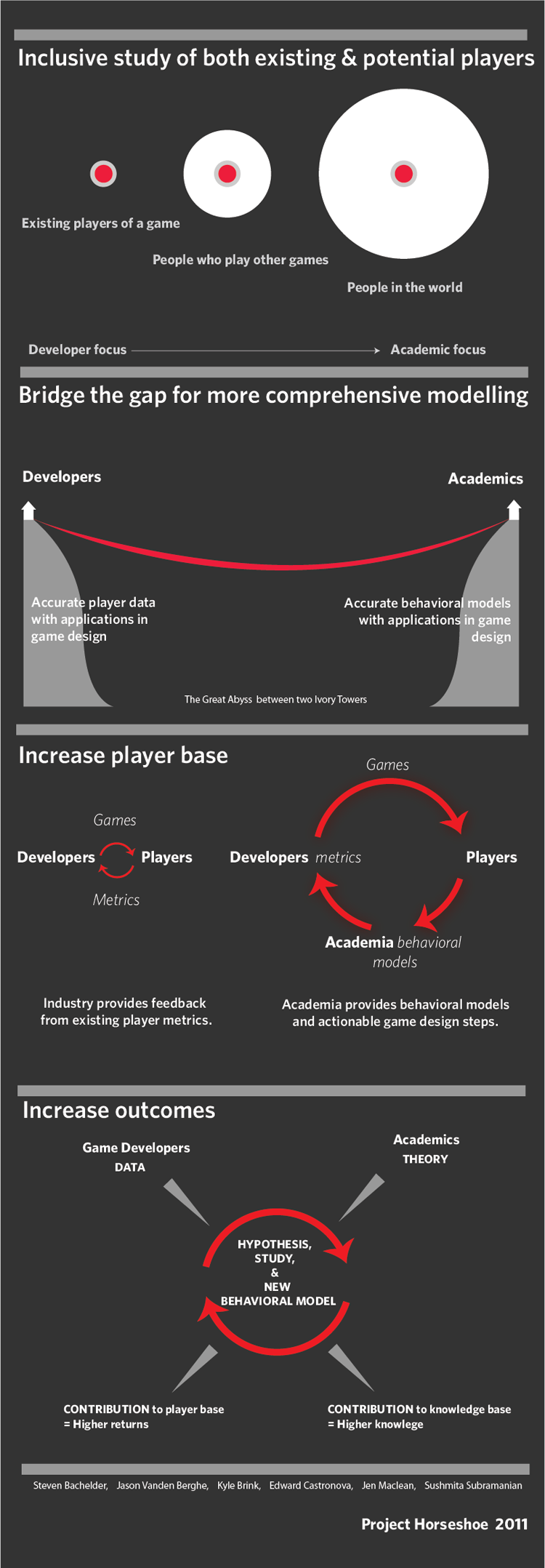
Our goal: Write a manifesto that instills fear and lust in academic and game industry leadership that motivates them to push for collaboration People in the gaming industry don’t understand the value of understanding psychological research towards game design. More specifically, they don’t understand how abstract academic models and findings can be applied to creating a successful game. Although the research may be based on existing successful games, it has not been proven that applying these models and theories during game design will guarantee a successful product; even experimenting with the data can be risky in time and money. The underlying problem is that folks in the gaming industry and those in academic research have different values, goals, and ultimately speak different languages. The former group is motivated by money (sales of their games), productivity (getting games out the door quickly), competitive advantage (often demonstrated through unique proprietary game design models), and agility. Academics, on the other hand, are motivated by what they can publish, how they can discover and establish the “truth”, and adoption/validation of their research findings by peers. There have been some limited examples of games incorporating academic research on a daily basis; Valve has a research psychologist whose job is described as "justifying his salary", and who studies things like physiological excitement during gameplay. By understanding research methodologies and applications in practical game development, Valve invests in better understanding their customer and the reactions to their products and, consequently, driving greater profit. Academics, meanwhile, study games in a way that is not useful to industry. Their models are too general; they focus on one or two AAA genres; they ask questions that game designers don't care about ("Is WoW post-colonial?"). Academics whose work could be very useful to industry (psychologists, sociologists, etc.) have no reason to use game data for their research.A brief statement of the group’s solutions to those problems The goal of this manifesto is to generate lust (and/or terror) in the hearts of game industry and academic leaders. The industry must realize that those who take advantage of academic research will better understand their data and the minds of their current, or more importantly, their yet-to-be-determined customers. Those who do not take advantage will lose market share. This type of collaboration will open up new markets for the game industry, leading to new revenue streams, and help the industry more effectively monetize their products. Game research has traditionally studied customers and measured engagement by looking at how many subscriptions people have and how long they hold these subscriptions. However, understanding customers requires deeper analysis and an understanding of systems, not just individuals. For example, studying individuals does not take into account how many others customers leave a game because of an individual’s actions within a game. Academic research has looked into games, such as World of Warcraft, to break down the game models and mechanics that made it so successful. The game industry should build in instrumentation and data collection from day 1 to support this type of research, and also game designers should be starting from the proven motivational models that are identified through this research. Academics need data to test their hypotheses, and are beginning to see the opportunities in collecting information through gameplay. From this, they can extract behavioral models that can be correlated with game principles and mechanics. However, there is a crucial and missing step needed to translate from abstract behavioral models to applied game mechanics and techniques that a designer can use in their game design. While the challenges are obvious, we've presented information on why the collaboration may benefit both parties in a "manifestographic" as well as a sample framework for a collaboration. As a follow up, we would also encourage, the investigation of a common forum to facilitate contact between researchers and game developers. Additional forms of matchmaking, including a specific conference on game research or sessions at industry conferences at GDC, would be helpful in introducing interested parties. Expanded solution description In order to effectively work across industries, its important that both parties understand the challenges and fundamental motivations of their counterpart. Both parties effectively speak different languages, and the most successful partnerships will involve significant translation. One way to expand the collaboration is to explicitly connect the partnership to a desired outcome; for the game developer, noting that they are not taking advantage of a resource their competition may use is a tactic to encourage partnerships. For academics, providing a sense of the incredible scope of data available, as well as the low cost involved in obtaining the information, and tying that asset to accepted measures of success like published research, is an effective motivator. Items from the brainstorming lists that the group thought were worth reporting In order to garner support amongst game developers for working with academia (and undertaking the work and expense involved in such), we must prove the value of understanding the human mind. That value can be measured economically in some cases (with the ability to attract more players and increase the revenue per player), but the game design community should also embrace the value of better understanding the player even without immediate, obvious economic benefit. Even understanding what does NOT work to increase revenue or engagement has value. A collaboration between academia and game development is most effective when the data analysis explains players’ fundamental behaviors and motivations rather than just surface-level actions and responses. A fundamental challenge to working together will be for academia to move at business pace; the faster the data is analyzed, the more value it has to the game developer. Game designers go off of institutional memory, instead of off of academic models/research; only when confronted with a market we don’t understand do we turn to academic research (e.g. mothers, women, children, old people). While we could attempt to hire people with practical experience in those markets, there is a significant supply problem. How do we then expand our use of basic market research on new demographics to create effective tools for behavioral understanding that give us a deeper comprehension of our current business as well as our potential success. A primary challenge is that game developers not only balk at reviewing large expanses of research, they simply don't understand what questions to ask of the data. Questions are overly broad like “how do I reach more people?”; academia should be the curator to help them narrow down their questions to something practicable and valuable, for example, “Why is my game is not doing as well as game Z?”. Understanding the difference between a designer's game and that of the competitor then leads to a greater understanding of the larger potential player audience and the motivational constructs that attract and retain them. We learned a cool new word: epiphenomenal. Most research analysis done by game developers tends to be epiphenomenal; it studies the outcome instead of the underlying system that creates the outcome (and its dependent and independent variable sets). Academia makes a practice of pushing deep explanatory analysis, and provides a toolset not generally found in game development and design. Other reference material Manifestographic
Role Play Script (PH2011_Skinnerz_Presentation_Script.docx)
section 3 |
|
|
Copyright 2000-2014, Fat Labs, Inc., ALL RIGHTS RESERVED |