previous
Project Horseshoe 2008
| The Third Annual Game Design
Think Tank Project Horseshoe 2008 |
|
 |
Group Report: Dramatic Choices |
| Participants: | |
Mirjam Palosaari Eladhari, Gotland University |
|
| with help from Project Horseshoe attendees, especially Allen Varney and Victor Jimenez | |
Problem statement How can a sandbox virtual world system for story construction with semiautonomous avatars be enhanced to cater for dramatic choices? (Problem statement derived from MP Eladhari’s research) A brief statement of a solution to this problem The approach MPE is experimenting with to explore story construction in virtual worlds include the use of semiautonomous avatars. (The Mind Module) The prototype game play draws upon the application of psychology in the Mind Module, where characters have personality, emotions, moods and emotional attachments to entities in the environment. One of the intended drivers for game play is our constant struggle for self knowledge where we mirror ourselves in each other. The current prototype is sandboxy. In order to enhance the possible experience in narrative terms, to cater for dramatic choices the following approaches might be interesting to explore:
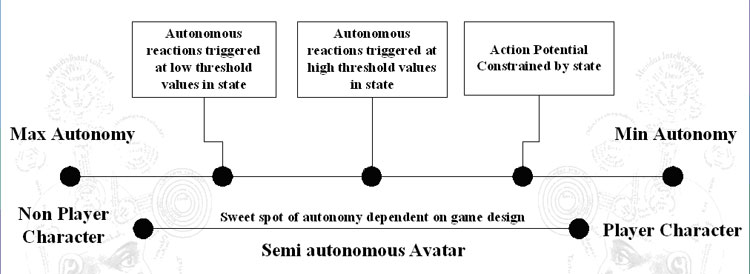
Expanded problem statement 1. Why do it in the first place? Six years ago I “took a break” from the game industry where I had been working as a lead game programmer for a short time period. I had, in the game we made, experienced a clash between two approaches; an object oriented approach to story logics where the casual dependencies where tied to objects and geographical locations, and a linear hypertextual tree structure that was put as an overlay. This led to false causal relationships, which resulted in solutions that were ugly from both a narrative perspective and from a systemic perspective. I spent almost a year tackling this, which led to a masters thesis called “Object Oriented Story Construction” and an AI paper called “Causal normalization”. During this period I started to suspect that a possible approach for story construction in large persistent systems with a multitude of players could be to further utilize the intelligence of the player, i.e. to use the artificial stupidity of current state of the art to, instead of making NPCs that MMO players don’t care about so much in the first place, enhance the player character. I call these entities semi-autonomous avatars. It might be possible to harness the power of human relationships and plotting in virtual environments if these are tied into the game mechanics to achieve drama where no characters are supporting parts, but instead main protagonists and antagonists from their own position in a relational network. Exploring this would take time. It came to my attention that there is a loophole for time and thinking in the form of doing a PhD. So I pursued that. 2. What is there right now? I started out mapping out my theoretical approach to story construction and narrative in games so I would be able to put it to rest. (“Story construction and expressive agents in virtual game worlds”, 2004) At the time there was a vivid discussion in the game studies field about the tension between narrative and game play. To me this appeared to be dead end, and I wanted to build instead, and see where it would take me. In order to see how to potentially use the intelligence of the human mind in junction to story construction I turned to the areas of psychology and neurology. I implemented an agent-based architecture for player characters in multiplayer games, the Mind Module. I built it as a spreading activation network, and it gives player characters personality, emotions, mood, and emotional attachments to other entities in the world. Potentially the emotional attachments can be combined in relationships to create drivers for player action, while the personality would make sure that the experiences are highly individual. I thought a lot about how these emotional values would be expressed to the player: i.e. the individual emotional state, and built, together with a composer, a prototype that expressed the values in the form of music. This, after all, is the language of emotion. (“The Soundtrack of Your Mind: Mind Music - Adaptive Audio for Game Characters,” 2006) In order to see whether the approach used in the Mind Module would be useful there needed to be a world for the modules to live in. During some years I incorporated it in three different projects with unsatisfactory results. The main problem areas where of two categories: Firstly, technological research projects are always under funded regarding implementation, a strong reason for that being that the success criteria is not measured by functioning shippable products but in publications. In two cases the development was cut just when we had platforms and frameworks in place so that we would be able to start doing interesting things. Secondly, there was a design problem. I had been rushing, and not been thinking deep enough. So I set about doing a full design, instead of just “plugging it in”. It has the tentative crappy title “World of Minds”, and takes place at the institute of Pataphysics (IP). The staff at IP have locked themselves into so disparate and alienated world views that membrane between reality as we know it and projections of mind is ripped apart. The player characters enter to investigate and deal with the situation. Together they can use affective actions and mind magic to defeat negative manifestations. What they can do depend on their personality and their current mood. Player’s can affect each others moods through interaction in order to modify the action potential. What I have been struggling with design wise is how to create potential for dramatic choices. i.e. How can I make it into something more than emergent story construction in a sandbox system? As far as I have gotten to this point is a system where player characters need to make choices of how they manage their time and effort. On one hand they would be able to sign social contract between each other. For example “romantic exclusivity”: This would give the benefit of a powerful mood boost in proximity to each other, and a permanent slighter boost, but would also require restriction in the use of affective actions toward other player characters. Combinations of social contracts and number of social contracts would be a management issue with dramatic potential. I had thought to combine this with the pursuit of principles, where a similar time management challenge would meet the players. The pursuit of principles would be measured by what types of actions the player performs in relation to the world, rather than in relation to other player characters. …But it doesn’t feel right. So this was the problem I needed help with, and all the above is what I explained in the rogue group. In short: How can I use the system of the mind module and redesign the WoM prototype to further support dramatic choices? Expanded solution description We were looking for approaches that can, combined with a sandbox virtual game world with semi-autonomous avatars, hold the potential for individually meaningful experiences for players. This includes being able feel that choices of the player character are meaningful and dramatic. (Semi autonomous avatars are player characters that have a level of autonomy apart from the player, where the level of autonomy depends on the game design. See section diagram below.) Approaches to explore:
In summary, the approaches I intend to try for story construction in virtual worlds include the use of semiautonomous avatars with emotional attachments with game play derived from the application of psychology in the Mind Module, combined with life path systems, information revelation and withholding by autonomous agents where the main driver for the game play is our constant struggle for self knowledge where we mirror ourselves in each other. All these approaches may not be possible to try in the same system. An inherent problem researching this is that existing general systems do not necessarily give context that in turn can give interesting results. Reversely, specialized systems may not provide us with solutions or answers that are general enough to be useful. Nevertheless doing this might be better than not doing it at all, and hopefully the voices coming from this project may have a pitch to add to the chorus of game development, game playing and game research. Items from the brainstorming lists that the group thought were worth reporting Quote from Richard Garfield (Magic the gathering): "all multiplayer games basically the same - a player who is good at one is often good at games of the entire genre. " Paper RP games that feature social interaction rules:
Betrayal of a relationship. Rating of how severe the relationship is. A rating of how prone an NPC would be to tell another player character about that betrayal.
-> Titles for the achievements. Other reference material
section 9 |
|
|
Copyright 2000-2014, Fat Labs, Inc., ALL RIGHTS RESERVED |